3D printing for rental-property maintenance: which small replacement parts make sense?
Updated · 9 min read
A missing cosmetic cap or cabinet knob may suit an authorized print. Check ordinary spare parts first, identify the fixture and accept one sample before a repeat order.
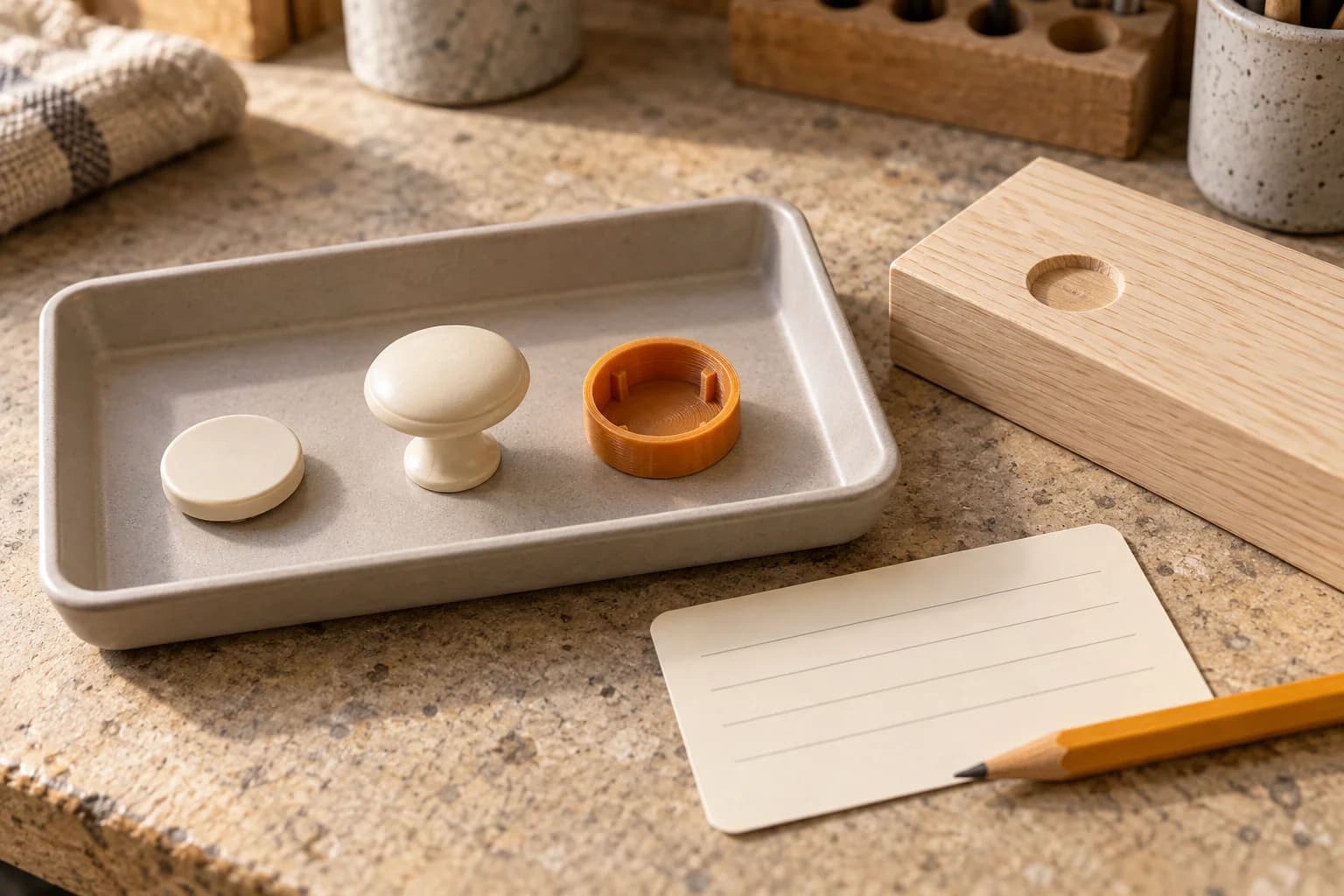
3D printing can be worth considering for a missing decorative plug, trim cap or ordinary cabinet knob during a rental turnover. Start with the original manufacturer and normal hardware suppliers. A printed replacement becomes a useful option when the part has a low consequence of failure, you have permission to reproduce a model for the exact fixture, and you can check one sample before ordering more.
The decision is about completing the repair. A cap that looks right but binds, a file for a different cabinet revision, or a sample that needs another visit can change the whole comparison. For Toronto and GTA property managers, the most useful preparation is a clear part record and a small, deliberate first order.
Check the spare-part route before the print route
Original equipment manufacturer, or OEM, parts deserve the first search. IKEA Canada, for example, offers a self-service route for free small assembly spares, including knobs and plugs. That does not confirm availability for your particular item, but it is a good reason to look up the part before preparing a print. IKEA Canada spare parts (verified: 2026-10-05).
Search by the fixture brand, model and part number. IKEA identifies its small spares with a six- to eight-digit code in the assembly instructions and explains where to find those instructions online. “White furniture plug” is a much weaker starting point than a recorded part code. IKEA parts-identification guide (verified: 2026-10-05).
For other fixtures, follow the manufacturer's support route. Hunter Douglas provides a parts finder and support contact for its window treatments; use that to identify the product and relevant spare rather than assuming a downloaded repair fits. Check Canadian ordering eligibility and the actual part's availability directly. Hunter Douglas parts support (verified: 2026-10-05).
Compare the complete paths: OEM spare, compatible retail hardware, a repair specialist, a matching fixture replacement, or an authorized print. Include the time to identify the part, obtain or prepare the model, order a sample and revisit the unit. Filament cost alone cannot tell you whether printing is the better choice.
A turnover decision table for small parts
Use this as a proposed screening checklist. The examples are hypothetical candidates, not parts we have tested or offer from a catalogue.
| Turnover finding | First useful action | When an authorized print may be worth a sample | Reason to choose another route |
|---|---|---|---|
| Missing decorative furniture screw-hole plug | Find the assembly manual and original plug code | Its only job is to hide the recess, and the model matches that opening | An original plug is available, or the piece also retains hardware |
| Missing cosmetic trim cap | Identify the fixture and the cap's interior shape | It covers a nonworking detail and can be checked without disturbing a mechanism | It protects against a hazard, interferes with moving parts, or its function is unclear |
| One ordinary cabinet knob missing | Compare matching retail hardware and the intact knobs | The authorized model has the correct attachment and acceptable appearance | Matching hardware is readily obtainable, the attachment is unknown, or the knob controls an appliance or lock |
| Decorative end cap missing from furniture | Confirm that the underlying item remains stable without it | The cap is purely decorative and carries no weight | It acts as a foot, stabilizes furniture or supports equipment |
| Several similar-looking caps missing across units | Identify each fixture variant before counting the batch | Representative fixtures match the sample's recorded variant | Different interiors, mounting details or environments are being grouped together |
Ask one plain question: what happens if this part comes loose, cracks or deforms? Keep this print route to small, low-consequence parts. Electrical and fire systems, locks and security hardware, plumbing, structural supports, equipment suspension and safety mechanisms need their appropriate original or specialist repair path. Small size does not change the function.
Our replacement-part guide goes further into model dimensions, mating features and sliced-file checks.
Give the fixture an identity before searching for a model
An exterior resemblance is not enough. Even manufacturer cosmetic parts have variants: Blum's MODUL catalogue distinguishes hinge-arm cover caps for straight, cranked and double-cranked applications, with different part references. That is an identification example, not a recommendation to print hinge components. Blum cover-cap catalogue (verified: 2026-10-05).
Keep one short fixture-and-part record with the maintenance job:
| Record field | What to save |
|---|---|
| Fixture identity | Internal asset or unit reference; brand, model and revision where known |
| Part identity and function | Manufacturer part number; what the piece actually does |
| Reference evidence | Photos of the fixture and an intact counterpart; relevant measurements with units |
| Model and permission | Source URL, author, exact licence or written permission, and file revision |
| Use conditions | Sun, nearby heat, dampness, handling and the actual cleaning routine |
| Sample result | Fixture checked, file revision, material selected, date, observations and acceptance decision |
| Repeat scope | Which confirmed fixture variants and units may use that result |
In a hypothetical turnover, two units have the same-looking wardrobe and a missing decorative cap. One wardrobe has a round recess; the other has a different internal mounting shape. Record them as separate variants, even if both caps would be cream and round from the front. A sample for the first unit gives you no fit result for the second.
Keep tenant names and personal details out of the print brief. The asset reference and technical information should be enough to connect the order to your own maintenance record.
Check what a downloaded repair file actually covers
A model listing should answer “which part?” as well as “what shape?” Compare the intended fixture, revision, units and mating surfaces with your record. If a match is uncertain, resolve it before slicing; an attractive render will not settle it.
SpaceElectro's published patio-blind repair is a useful example of a narrow model. It addresses a broken slot in a PVC vane. The creator reports a PLA prototype and raises sun-heat warping as a concern. Those details do not establish suitability for another vane, or for the headrail, cord or safety system. The page also did not show a reproduction licence in our review, so it is not a cleared file recommendation. SpaceElectro's blind-vane project (verified: 2026-10-05).
Save permission alongside the file, not just the download link. Read any business-use, attribution or modification conditions. Creative Commons explains that NonCommercial use depends on the circumstances and intent, and advises contacting the rights holder when the answer is unclear. A rental-maintenance use should not simply be assumed to be personal use. Creative Commons licence FAQ (verified: 2026-10-05).
Our downloaded-model guide explains the permission and file-preparation checks before an order.
Accept one sample against the real fixture
Write down the acceptance checks before you order. Otherwise it is easy to accept a neat-looking print without checking the feature that matters.
A downloaded model can still fail during fitting. In a firsthand iFixit account, Charlie Sorrel describes a retaining tab breaking as he fitted a printed grinder part. That appliance repair is outside this article's candidate scope, but the observation illustrates why file availability is not a fit result. Charlie Sorrel's repair account (verified: 2026-10-05).
For a cosmetic cap or ordinary knob, we suggest these sample observations:
- Match: compare it with the intended fixture and intact counterpart, including its underside and attachment.
- Fit: check for interference, rocking, gaps or cracks during careful fitting. Do not force a binding piece or hide a dimensional mismatch with glue.
- Ordinary handling: check the intended low-consequence use and removal without damaging the fixture. Reject sharp edges, looseness or deformation.
- Appearance: decide whether visible layer texture, colour and surface finish are acceptable in that location.
- Cleaning: assess the expected cleaning exposure on the sample and record any visible change. Follow the cleaner's instructions; do not invent a harsher test mixture.
Choose a material for those conditions from the options currently available in the ordering flow. Record the cleaner product, dilution, wiping method and contact time. “It gets cleaned” is not a useful material brief.
Prusament's chemical-resistance work uses defined materials, chemicals and exposure periods, and describes its compatibility table as indicative. Temperature, concentration and mechanical stress matter. Its results cannot give a blanket answer for repeated wiping with your commercial cleaner. Prusament chemical-resistance tests (verified: 2026-10-05).
Similarly, Polymaker's PETG datasheet says its typical values are for reference and comparison, with end-use performance affected by design, environment and printing conditions. A material label or datasheet does not qualify a finished replacement. Polymaker PETG technical datasheet (verified: 2026-10-05).
Record a sample as “fit accepted on this fixture under these observations.” That supports a limited next order; it does not establish a service life.
Repeat the recorded variant, then prepare the order
Before ordering a set, confirm representative fixtures against the part record. Keep different mounting shapes separate. Save the accepted model revision, intended material and sliced file so another person can see exactly what was approved. Recheck when the fixture, model, material or use environment changes.
We print authorized customer models supplied as compatible pre-sliced .3mf or .gcode files. An unsliced .3mf has an opt-in auto-slice route, subject to availability. A photo, broken part or raw STL alone is not a ready order; model creation and installation belong with your own team or an independent specialist.
Use our STL-to-print-ready guide if you have geometry that still needs slicing. Then upload the compatible file, select a currently stocked compatible filament and review the CAD quote. Free scheduled Toronto pickup and Canada Post shipping are subject to the ordering options. Use the current quote and fulfillment information when planning the turnover.
If several matching units need the same accepted part, adapt the repeat-accessory batch record to keep the fixture revision and checked print context together.
For a torn attachment opening in a lightweight vertical vane, the blind-vane repair-clip guide shows how to compare ready-made tabs and match a sample to the actual profile.
After accepting a small replacement, use the maintenance print-file library workflow to preserve its source, export and fit history for the next turnover.
For a discontinued product, the repair-shop OEM-or-print checklist records the decision to order an original spare, authorize a limited trial or refer the repair.
Questions before the next maintenance order
Can we order a replacement from a photo?
A photo helps identify and compare the part, but we need an authorized printable model. We do not provide scanning, reverse engineering or replacement design through this ordering flow. If no suitable model exists, an independent CAD or repair specialist is the next step.
Is printing cheaper than an original spare?
Compare the whole repair path, including model preparation, the sample and any additional visit. An available OEM plug or matching retail knob may be the simpler choice. Use an actual current quote rather than assuming a small print creates savings.
Can one file cover every unit in a building?
Only include units whose fixtures match the recorded variant. A shared address, purchase period or cabinet colour does not confirm identical mating geometry. Keep a unit-to-variant reference and inspect representative fixtures before a repeat order.
Can we use a free replacement-model download?
Check the exact licence and any written permission for your intended reproduction and use. A free download describes the acquisition price; it does not answer every permission question. Keep the source and terms with the part record so a repeat order can be checked.
Research verified: 2026-10-05.
Have a sliced file ready?
Upload it for an instant quote in CAD.