Discontinued plastic parts: an OEM-or-print checklist for repair shops
Updated · 8 min read
A repair-shop bench ticket for checking discontinued plastic parts: identify the exact part, record the OEM search, assess an authorized model and decide what one sample needs to prove.
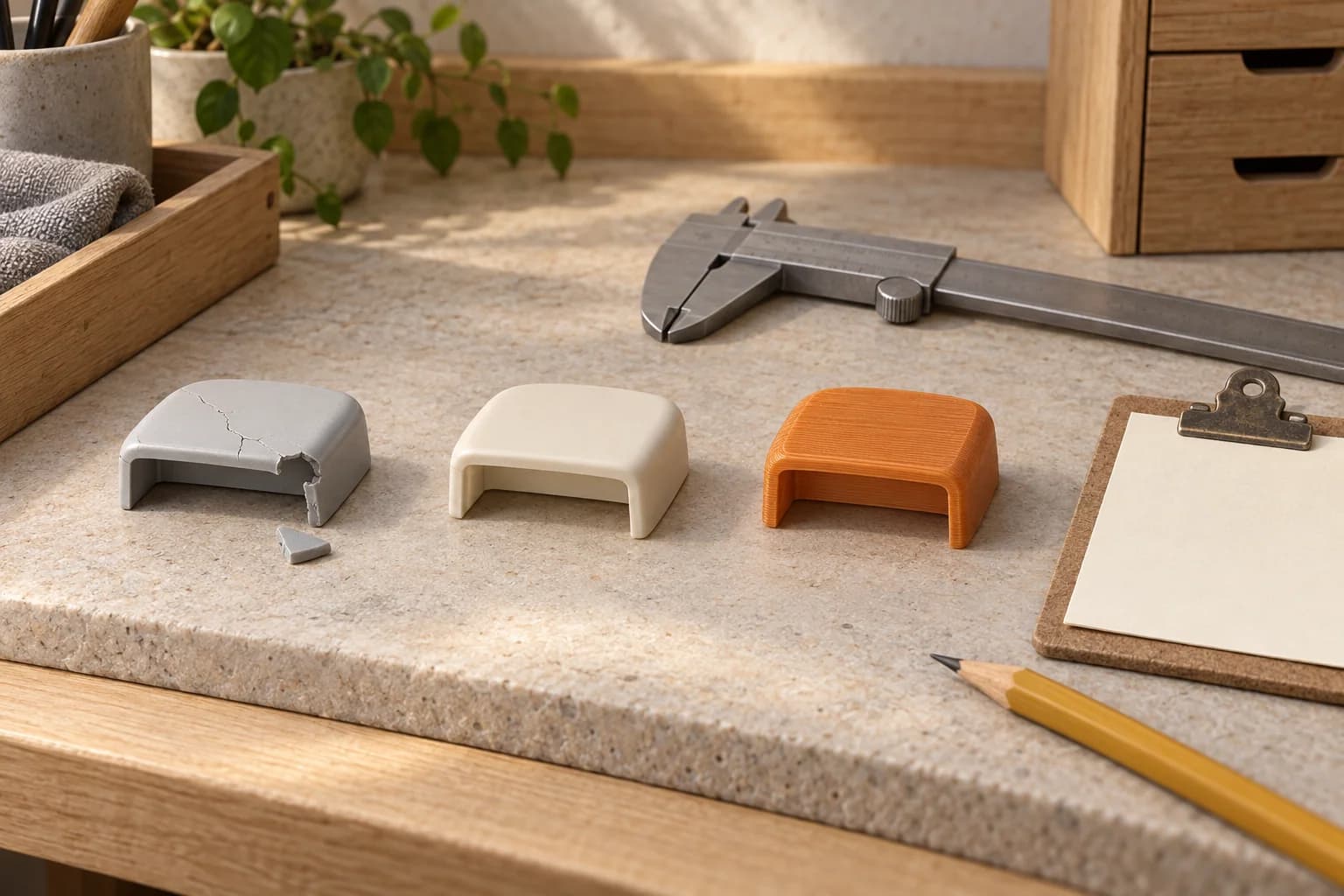
For a discontinued plastic part, check the original equipment manufacturer’s (OEM) spare-parts route first. Consider a 3D print only when the part has a clear, low-consequence job, an authorized model matches the exact product, and the shop can inspect a sample in its intended use. The repair ticket should end with one of three decisions: order an OEM or approved spare, authorize a limited print trial, or decline and refer the replacement.
That decision starts before a print quote. “Discontinued” describes the product; it does not settle spare availability. IKEA Canada, for example, directs customers with discontinued products to contact staff with the product information so they can check the required parts, availability and cost.1
Give the missing part an exact identity
Before searching for a replacement, write down the manufacturer, complete product model and revision, relevant production identifier, and part number or diagram callout. Photograph the broken part and the place it belongs. Describe what failed: a missing corner, worn contact edge or cracked retaining feature is more useful than “broken plastic piece”.
Manufacturer tools show why that precision matters. Bosch’s US replacement-parts page uses the appliance model number, or E-Nr, to retrieve diagrams and parts lists, and identifies the rating plate as the source of that number.2 Treat this as an identification example, not evidence of Canadian stock. For a Canadian repair, use the manufacturer’s Canadian support and distributor routes; Bosch Canada lists these on its support page.3
Keep a dated sourcing note. Record the actual link or supplier response, the exact part checked, any approved replacement number, and the quoted price and lead time. Use a status that says what you know:
- Temporarily out of stock: availability may change; record the expected next step.
- Product discontinued: the spare still needs checking.
- Not sold separately: ask whether an approved assembly or substitute is offered.
- Availability unconfirmed: no answer yet; do not turn this into “unavailable”.
- Confirmed unavailable through the checked channel: retain the dated response and consider the other routes.
An inspected genuine donor part may be another option for the repair specialist to assess. Keep its provenance separate from a marketplace listing that merely looks similar.
Write the function before choosing the route
Our proposed checklist is a practical shop record, not a manufacturer procedure. Start with two sentences: “This part does…” and “If it fails, the result is…”
A loose drawer-label insert or cosmetic trim cap on a storage accessory may be worth investigating. These are hypothetical candidates, not repairs we have completed. Confirm that the part does not also support, protect or retain something important. If its function is unclear, pause the print route.
Our service scope excludes structural, equipment-suspension, electrical/fire, security, pressure, medical, food-contact and other safety-critical or certified applications. The terms of service set out the allowed scope. A small plastic part does not earn an exception because it is easy to model.
| Route | Evidence to put on the ticket | Next action |
|---|---|---|
| OEM or approved spare | Exact compatibility, supplier response, price and lead time | Quote the complete repair using that part |
| Limited print trial | Low-consequence function, authorized matching file, known environment and written sample criteria | Quote one sample and agree the shop’s inspection and revisit plan |
| Decline or refer | Unclear function, consequential failure, missing permission or no suitable model | Explain the unresolved point and refer to the appropriate supplier or specialist |
Choose the route on the evidence. Do not let an urgent deadline stand in for an answer about what the part does.
What documented repairs tell us
In a March 2026 iFixit article, Charlie Sorrel described a printed coffee-grinder retaining tab breaking while he fitted it. The same report includes iFixit’s Chayton Ritter’s tape-gun wiper replacement, which Ritter said was still working after heavy use.4
These are individual reported outcomes, not a lifetime comparison. The grinder example is a reason to stop and reassess, not a food-equipment application we offer. The tape-wiper account shows a successful particular repair; it does not establish that another file, material or application will perform the same way. On a shop ticket, “the sample cracked during fitting” is a failed trial, even if most of the shape looks right.
Check the repair file’s identity and permission
A useful model listing should tell you what product it fits and what problem it addresses. Prusa’s historical replacement-parts contest asked for the exact product, a defect and repair description, and relevant photographs. That is a useful documentation example, not a qualification standard.5
For your own record, save the source URL, creator, download date, file/version, stated compatible revision and licence or written permission. Keep any attribution requirements and a note of changes made by a separate designer. A photograph of someone else’s successful make can help with comparison, but it cannot fill a missing product revision on your ticket.
Free download is not the same as permission for the proposed paid use. Creative Commons distinguishes licences that allow commercial use from those with NonCommercial restrictions, and its FAQ explains that context matters when assessing NC use.67 If the intended arrangement is unclear, get permission from the rights holder or choose a file whose terms cover it. Our downloaded-model guide covers the preparation and permission checks.
An OEM file can be another route. Philips describes its Fixables initiative as a Czech pilot for small external accessories, with recommended materials, while continuing to offer original spare parts.8 Check the specific file’s instructions and permissions; this is not evidence that a particular Canadian replacement or paid printing arrangement is available.
Order one sample to answer a written question
Before ordering, decide what you need the sample to demonstrate. For a hypothetical cosmetic storage cap, the question might be: “Does this revision seat and remain removable on the identified storage accessory without force or visible damage?” Appearance can be part of acceptance, but give the contact surfaces their own checks.
Record heat, sunlight, moisture, cleaners, flexing and wear that the part will actually encounter. Material guidance helps screen a choice: Prusa describes PLA as useful for detailed models and quick prototypes without high mechanical, chemical or temperature demands; its PETG guide describes useful tenacity and layer adhesion alongside printing compromises.910 Neither description establishes equivalence to the original part. Choose from the compatible materials currently stocked in the quote flow.
Agree the sample check and stopping conditions with the customer before treating a trial as a completed repair:
- Compare the received part with the recorded reference and mating accessory. Check the relevant contact edges and features, not only overall appearance.
- Try the agreed fit without force. Stop for binding, cracking, deformation or damage to the mating item.
- Exercise only the intended low-consequence function. Check retention and removability, and look for wear or permanent change during the agreed observation period.
- Record the date, observations and limits of the check. Use “fit trial passed under recorded conditions”, “needs external revision and another trial”, or “declined”.
Do not assign a universal clearance or infill recipe to every replacement. For the detailed file, fit and slicing checks, use our replacement-part guide. Keep the accepted model, slice, selected material and orientation with the observations. A relevant change to those inputs needs another assessment; one accepted sample is not approval for every similar item.
Keep a decision record that another technician can use
The following bench-ticket fields are our proposed working checklist. They belong in the shop’s records; we are not describing a website feature.
| Field | Minimum useful entry |
|---|---|
| Part identity | Product model/revision, part number or callout, photographs and function |
| Dated OEM search | Channels checked, responses, spare/assembly alternatives, actual quotes |
| Trial reason | Why this low-consequence candidate merits a sample |
| Authorized file | Source, creator, version, permission and compatibility evidence |
| Sample plan | Environment, mating features, acceptance and stopping conditions |
| Result | Dated observations, accepted inputs and unresolved limitations |
| Final decision | OEM, bounded print use, external revision or decline; explanation given to customer |
| Reorder reference | Accepted file/slice, material and conditions that require rechecking |
Compare the whole repair before quoting: sourcing time, OEM part or assembly and freight, sample cost, any external design work, inspection and installation time, downtime, and a possible revisit. Use actual quotes. The amount of filament does not represent the complete repair bill.
For a Toronto print trial, we print authorized customer models supplied as compatible pre-sliced .3mf or .gcode files. An unsliced .3mf has an opt-in auto-slice path, subject to availability. If the download is an STL, follow the STL-to-print-ready guide before ordering. Scanning, CAD creation, reverse engineering, model repair, installation and certification are outside this service.
With the file ready, upload it for a current quote in CAD, select a compatible stocked filament and review the order details. Free scheduled Toronto pickup and Canada Post shipping are available according to the ordering options. Keep the print order reference on the repair ticket alongside the shop’s assessment.
For rental turnovers, the property-maintenance replacement guide adds a way to identify matching fixtures before repeating an accepted cosmetic part.
Keep the removed hardware with a numbered tray and repair job record while waiting for the replacement decision, so reassembly notes stay with the parts.
Questions repair shops ask
Can a discontinued product still have OEM spare parts?
Yes, it is worth checking. IKEA Canada explicitly offers a staff enquiry route for discontinued-product parts.1 Record the response for your exact part; the enquiry route itself is not a stock guarantee.
Can we send a photo or broken part instead of a model?
A photo helps your identification record, but our print order needs an authorized compatible file. If no suitable model exists, obtain design work separately before preparing the print order.
Does a free STL allow paid repair work?
Check the actual licence and intended use. A free price does not remove licence conditions; Creative Commons’ own guidance distinguishes commercial permissions and NC restrictions.67 Save the terms or written permission with the file.
Is PETG automatically an equivalent replacement?
No. A material’s useful properties are a screening input, not proof that a finished sample matches an OEM part.10 Record the intended environment and sample result rather than calling the part equivalent.
What should we save after an accepted sample?
Keep the exact product identity, dated OEM search, authorized model and slice, material, observations, accepted use and customer explanation. For a reorder, check that those inputs and conditions still match before relying on the earlier result.
Sources checked
IKEA Canada: How do I order small spare parts?, discontinued-product enquiry instructions; verified: 2026-10-05.
Bosch US: Appliance replacement parts, E-Nr and rating-plate instructions; verified: 2026-10-05. No selected stock was checked.
Return to text: 1
Bosch Canada: Get support, Canadian support and distributor links; verified: 2026-10-05.
Return to text: 1
Charlie Sorrel, iFixit: 3D Printing Spare Parts Is Cool But Not A Silver Bullet, published 2026-03-05; verified: 2026-10-05. Reported individual repairs, not our tests.
Return to text: 1
Prusa Research: Contest: Replacement Parts, historical documentation requirements; verified: 2026-10-05.
Return to text: 1
Creative Commons: About CC licences, licence conditions; verified: 2026-10-05.
Creative Commons: Frequently asked questions, NonCommercial interpretation; verified: 2026-10-05. This checklist does not clear a particular model’s rights.
Philips Czech Republic: Fixables, pilot scope, recommended materials and continued OEM spare supply; verified: 2026-10-05. Canadian supply and specific paid-use permissions were not verified.
Return to text: 1
Prusa Knowledge Base: PLA, general material guidance; verified: 2026-10-05.
Return to text: 1
Prusa Knowledge Base: PETG, general material guidance; verified: 2026-10-05.
Have a sliced file ready?
Upload it for an instant quote in CAD.