Blind-vane repair clips: test one before ordering a batch
Updated · 9 min read
A torn vertical-blind attachment opening needs a specific repair. Compare ready-made options, measure a sound vane, and check one authorized print before repeating it.
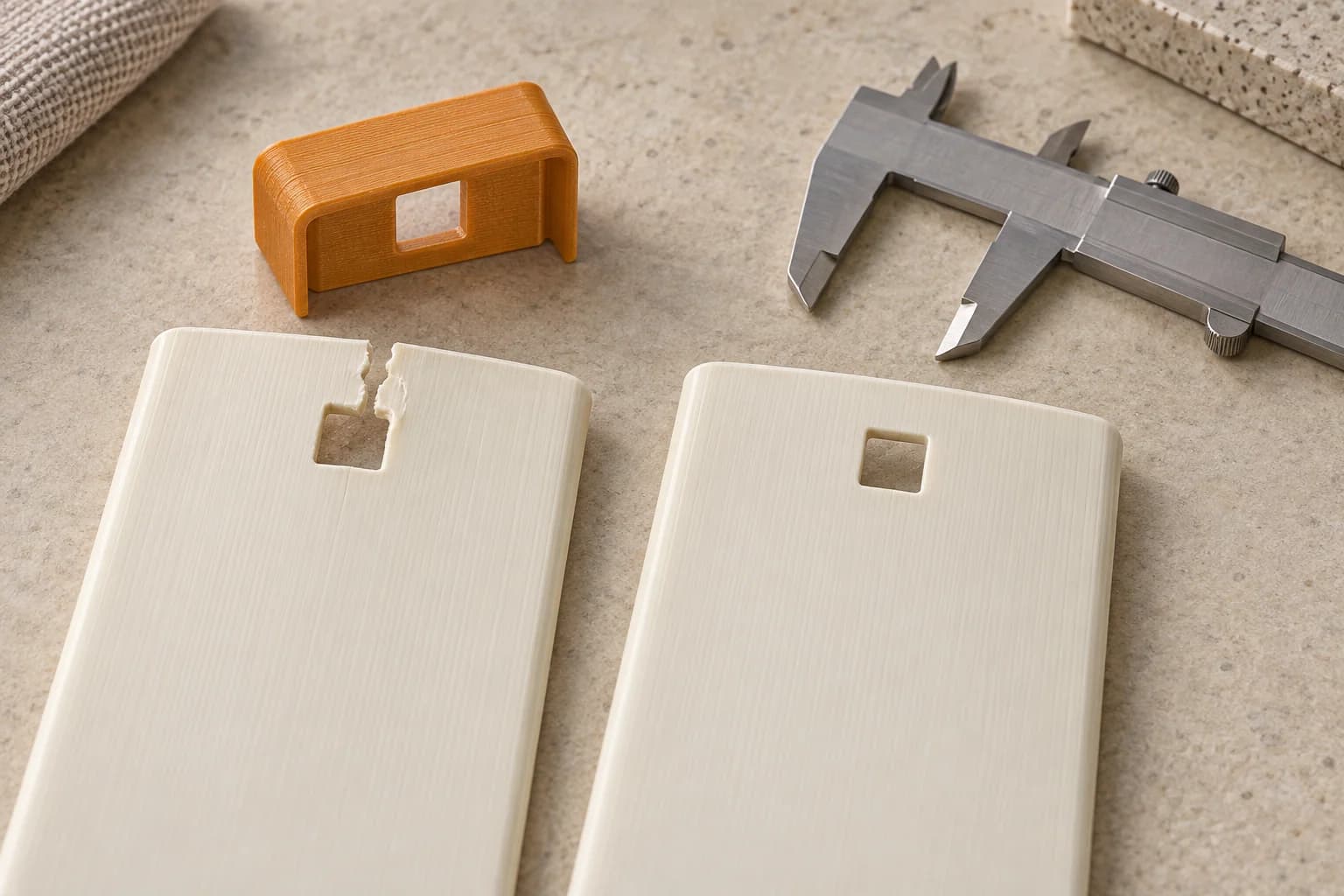
A 3D printed vertical blind repair clip is worth considering when the attachment opening at the top of a lightweight vane has torn, the carrier is intact, and you have an authorized model that matches the vane. Compare a replacement vane and ready-made repair tabs first. If printing still makes sense, check one sample on that exact blind before ordering clips for matching vanes.
For property maintenance contractors, the useful record is more specific than “vertical blind clip, white.” It identifies the vane profile, attachment opening, carrier engagement and print setup. That record should travel with the reorder file.
Check which part actually broke
Look at a sound neighbouring vane and its attachment before searching for a file. Has the material above the vane's opening torn away, or has the carrier clip above it broken?
Blinds To Go's vertical-blind guide treats these as separate repairs: replacing a carrier clip and using a VaneSaver for broken plastic above the vane's square slot. A sleeve over the vane top addresses the latter. It does not replace the moving component in the headrail. Blinds To Go guide, printed page 10, verified: 2026-10-05.
This article covers only that small attachment repair on an individual lightweight vane. Carriers, gears, cords, chains, tension devices, motors, mounting brackets and heavy panels need their own correct parts and procedures. A repaired vane also says nothing about the condition or compliance of the complete blind. If the rest of the vane is cracked or deteriorated, investigate replacement rather than treating the top opening as the whole problem.
Compare the parts you can already buy
A printable model is one option among several. Use the blind's identification and a sound vane to compare them, then check current availability for your location.
| Option | What to check before choosing it |
|---|---|
| Replacement vane | Exact product, profile, finish, attachment opening and vane length. LEVOLOR lists replacement-vane ordering routes and explains that overall blind height includes a headrail deduction; do not substitute overall height for vane length. LEVOLOR guide, PDF page 13, verified: 2026-10-05. |
| Manufacturer repair accessory | Whether the blind maker has a repair part for this failure and this product. Blinds To Go documents its VaneSaver accessory separately from carrier parts. Manufacturer guide, verified: 2026-10-05. |
| Metal vane saver | Vane profile and the supplier's compatibility details. Fix My Blinds describes a metal clip that fits over the damaged top and recreates the attachment hole. Vane-saver guide, verified: 2026-10-05. |
| Adhesive repair tabs | Opening alignment, surface condition and the kit's instructions. HOME SOGEWO describes clear PVC tabs applied on both sides, starting with a clean, dry surface. This is the seller's method, not independent adhesion testing. Repair-kit page, verified: 2026-10-05. |
| Authorized printed clip | A model that matches the measured vane and attachment method, plus a satisfactory sample fit. A public creator's example establishes one design approach, not compatibility with your blind. SpaceElectro's project, verified: 2026-10-05. |
Follow the instructions for the option you choose. An adhesive step from one design is not automatically appropriate for another. Check the exact blind and the supplier's current availability before ordering, and include print-file preparation and a sample check in your comparison.
Measure a sound vane, not the stretched opening
Nominal width is only the start. Shade Doctor of Maine sells a curved metal saver and specifically directs buyers with perfectly flat vanes to a different version. That distinction is a good reason to record the actual profile before selecting a model. Curved vane-saver specification, verified: 2026-10-05.
We suggest the following fit record. It is a practical checklist, not a manufacturer-approved specification or a set of universal tolerances.
| Record | Include |
|---|---|
| Blind identification | Manufacturer, product label or order reference, and location of the blind |
| Vane body | Measured width and thickness at the contact area; flat or curved profile; which face points into the room |
| Sound attachment opening | Shape, width, height and distance from the top and side edges |
| Damaged top | Extent of the tear and the remaining sound material where the proposed clip contacts it |
| Existing attachment | Photos of the intact carrier and a sound vane attached to it, following the blind's handling instructions |
| Hanging position | Vane length, alignment beside its neighbours and current bottom clearance |
| Environment | Window position, direct sun, heat exposure, cleaners and ordinary handling |
Take clear front and side views as well as a close view of the opening. Keep the measurements with them; photographs alone are not a printable model. Avoid deriving the intended opening size from a tear that has stretched or lost its upper edge.
Compare this record with the model's actual geometry and units. A file name containing the same vane width is not enough to release a batch.
Give the first sample three fit checks
Before ordering, inspect the sliced preview around the opening, thin walls and contact faces. Confirm that the features the model depends on are still present in the slice. Choose the orientation deliberately and retain it with the file; we do not prescribe one layer height, infill percentage or clearance for every clip.
Once the sample arrives, follow the blind's handling instructions and the design's attachment method. Our proposed check has three parts:
- Clip to vane: does the sleeve seat as intended without force, further cracking, unwanted bending or a loose fit?
- Opening to carrier: can the intact carrier engage fully with the new opening, rather than catching only an edge? Does the vane hang at the intended height?
- Vane to surroundings: does ordinary, gentle rotation and movement along the rail leave clearance to neighbouring vanes, the headrail and the bottom surface?
Checking movement matters as well as checking the hole. LEVOLOR identifies vane direction and space around open and closed vanes as troubleshooting points for poor operation. Our three-part check applies that observation to the proposed repair; it is not LEVOLOR's approval of a printed clip. LEVOLOR guide, PDF page 13, verified: 2026-10-05.
Set aside a sample that slips, rubs, deforms or cracks. Record what failed before changing the model. A brief movement check can reveal a fit problem, but cannot establish long-term durability.
Keep fit and window exposure separate
SpaceElectro's documented prototype used PLA, with a caution that sun heat might warp the clip. Prusa also identifies low UV and temperature resistance as PLA limitations. A sample that fits indoors has not answered the sunlight question. Creator's project and Prusa PLA guidance, verified: 2026-10-05.
Prusa describes PETG as a material used for technical parts with temperature resistance. That is screening information, not a recommendation or durability result for this particular clip. Select from the stock actually offered in the order flow and check the selected material against the environment; if suitability remains unresolved, keep the sample for fit evaluation only. Prusa PETG guidance, verified: 2026-10-05.
Release a batch by matching profile
Before reordering, keep these items together:
- The vane measurement record and photos, with a clear profile identifier.
- The exact source model, revision, units and reproduction permission.
- The sliced file, orientation and selected material SKU.
- The sample observations: seating, carrier engagement, hanging height and movement.
- The locations whose vanes match that record, and the intended quantity for each group.
A hypothetical maintenance file might contain one entry for a flat vane and another for a curved vane. Even if both are described as the same nominal width, treat them as separate fit groups. Check the proposed batch against the successful sample's setup. Changing the geometry, material or orientation calls for another sample check.
Inspect the received batch for obstructed openings and visible defects before distributing it. Keep one physical reference with the record if useful. A reorder should point to a specific setup, not depend on someone remembering which download worked.
Prepare an authorized file for a Toronto print order
Download access does not settle reproduction rights. We did not find an explicit file licence on the opened pages for SpaceElectro's example, so it is a design reference here, not a cleared paid-print recommendation. Project page, verified: 2026-10-05. Some licences have explicit restrictions: the Creative Commons BY-NC deed includes a non-commercial condition. Resolve permission for the intended order when terms are unclear. CC BY-NC 4.0 deed, verified: 2026-10-05.
At 3dPrintsToronto, we print authorized customer models supplied as compatible pre-sliced .3mf or .gcode files. An unsliced .3mf can use the opt-in auto-slice route when available. A photo or raw STL is not a ready checkout file; use our STL-to-print-ready guide for preparation. We do not include CAD design, scanning or installation in a print order.
Once the sample file and material choice are ready, upload for a quote. Review the CAD quote and current options for free scheduled Toronto pickup or Canada Post shipping when offered. For broader part selection, our replacement-parts checklist covers the decisions to make before slicing.
Use the broader property-maintenance screening checklist when deciding whether another broken blind component belongs with an original spare rather than a print.
Keep an accepted clip variant in a maintenance print-file library so a later order can distinguish vane profiles and obsolete revisions.
Questions before a repair-clip order
Can one clip fit every vertical blind?
Do not assume universal fit. Compare profile, contact thickness, opening geometry and assembled clearance. The curved-versus-flat distinction in a commercial saver listing illustrates why width alone is incomplete. Shade Doctor specification, verified: 2026-10-05.
Should I buy a vane saver or print a clip?
Start with the correct replacement vane or compatible repair accessory. Consider printing when you have permission to reproduce a model that addresses the measured fit. Compare the preparation, sample check and sourcing effort for the available options.
Is PLA a sensible choice beside a sunny patio door?
Treat it cautiously. The published prototype's creator raised sun-heat concerns, and Prusa notes PLA's low UV and temperature resistance. Passing a fit check does not resolve those limitations. Creator's project and PLA guidance, verified: 2026-10-05.
Can I order a batch as soon as one fits?
Use that result only for matching vanes and the recorded setup, with material suitability considered separately. Retain the revision and slice, inspect the batch, and repeat the sample check when relevant details change. One successful sample is a fit observation, not a lifespan guarantee.
Research verified: 2026-10-05; no physical fit or durability test was performed for this article.
Have a sliced file ready?
Upload it for an instant quote in CAD.