3D printed cable combs for network and AV installations
Updated · 8 min read
Choose between a removable dressing tool and a retained separator, check actual cable and connector dimensions, and test one sample before a repeat order.
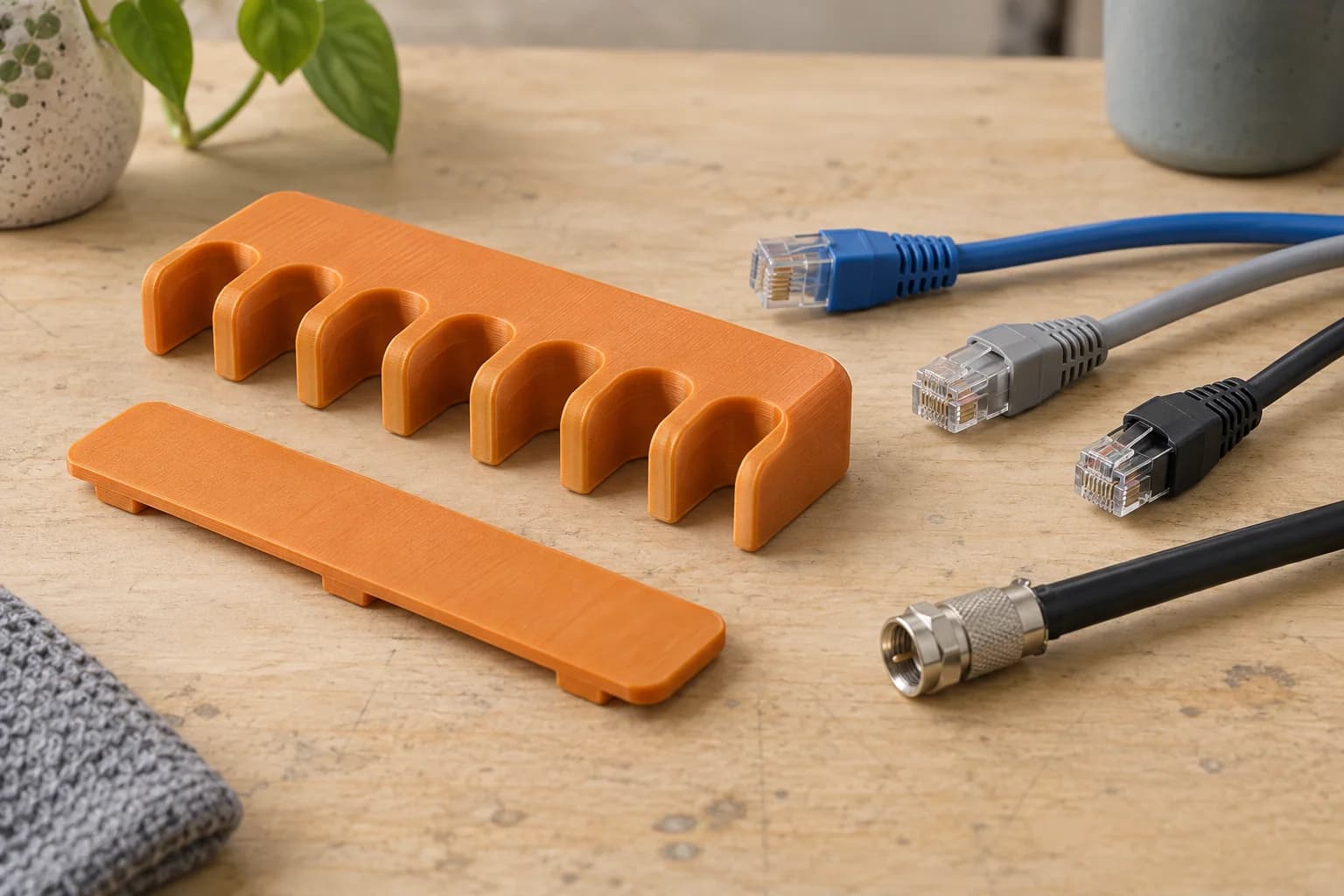
A 3D printed cable comb can make sense for an unusual cable count or arrangement, provided you have an authorized model and a sample fits the actual leads. Start by deciding whether you need a tool that comes off after dressing or a separator that stays in place. Then check jacket diameter, connector access and the space around the accessory. Compare an available manufacturer accessory before making a custom one.
Which kind of cable comb do you need?
The name covers different objects. Panduit's CBOT24K, for example, is a removable organizing tool with interchangeable inserts for specified cable-diameter ranges. Its instructions finish by sliding the tool off the bundle.1 Uenbzsto's Network Cable Comb V2 takes another approach: a bracket with a hinged retaining cover, offered in 4-, 8-, 12- and 16-cable versions.2
Use the intended job to narrow the choice:
| Your task | Accessory to compare | Fit and access question |
|---|---|---|
| Put spare leads in order while dressing a bundle | Removable dressing tool | Does the insert match the actual jackets, and can the tool come off without threading plugs through it? |
| Keep a small, accessible group of identified leads separated | Retained separator | Can each lead enter and leave independently, and does the cover close without squeezing a jacket? |
| Provide an established rack cable pathway | Manufacturer rack manager | Do the exact manager's dimensions, access and documented cable-management features meet the requirement? |
For the third task, compare the rack manufacturer's accessories or an appropriate commercial manager. Panduit's PatchLink sheet, for example, documents rounded fingers, hinged access covers and bend control at pathway transitions.3 A printed separator should be considered only for low-consequence sorting: required support and routing remain with the existing infrastructure. It is not equipment support, strain relief or a replacement for a specified wiring-management product. Our service terms set out the permitted uses.
Keep identification independent of the comb position. A cable should still be identifiable when someone removes it or changes the order.
Measure the jacket, then check the connector
“Cat6” in a filename is not a dimensional specification for your cable. These manufacturer examples show why the exact product matters:
| Exact cable product | Type | Nominal jacket outside diameter |
|---|---|---|
| Belden 2412 | Category 6 U/UTP | 5.69 mm4 |
| Belden 10GXW53 | Category 6A F/UTP | 6.73 mm5 |
| Belden 1694A | SDI video coax | 6.96 mm6 |
These are cable dimensions, not recommended comb-slot sizes. They also do not establish the diameter of a terminated patch lead from another range. Check the current sheet for your exact product and measure a spare piece without compressing its jacket.
Record the connector and boot separately. A slot may accept the jacket while a closed opening prevents the plug from passing through. An open-sided or split design is worth evaluating when the leads are already terminated. Check how it actually opens; a hinge in a preview image does not establish usable clearance on the finished print.
Avoid choosing a universal clearance allowance. Instead, compare the model's opening with the actual cable, then use a physical sample to resolve fit. If a feature needs changing, edit that feature in an authorized source model and reslice. Enlarging the whole comb also enlarges its spacing, cover and fastener features.
Leave room for the next cable change
A tidy row is only useful if it remains accessible. Before ordering, check the proposed accessory against the surrounding space:
- Can its cover open fully without hitting an adjacent panel or accessory?
- Can one lead be removed without disturbing the whole group?
- Will the cable labels remain visible?
- Does the arrangement leave the cable path and the manufacturer's handling limits intact?
Use the exact cable's handling guidance for the relevant condition. Belden's 2412 specification distinguishes stationary and installation bend limits; the 10GXW53 sheet states an installation minimum.45 There is no single bend-radius number to infer from these examples. Belden's Bob Ferguson also explains why altered cable geometry and handling damage matter.7 A tighter-looking arrangement is not a reason to force a jacket into a slot or drag a rough surface along it.
For a hypothetical bench group of eight identical spare leads, repeated openings may be a reasonable layout to test. Change that group to network leads, coax and differently sized AV cables, and the same model needs another review. Separate groups, an authorized model with different openings, or the existing commercial manager may be easier to service.
Give the first sample a specific job
Order one sample before choosing the repeat quantity. Use spare, disconnected leads on a bench so you can inspect the contact points and practise individual removal.
Our proposed sample checklist is:
- Inspect the empty print. Look for sharp contact edges, stray filament, incomplete fingers, cracks and a cover or latch that binds.
- Try every actual cable type. Check entry and removal at each opening. Reject a fit that requires forcing the jacket or leaves visible indentation or abrasion.
- Close the cover. Check that it reaches its intended position without pinching the leads. Open it again and inspect the jackets.
- Rehearse a change. Remove a middle lead and replace it while the others stay in their intended positions. Confirm labels and connector access remain usable.
- Record the accepted combination. Save the file revision, relevant dimensions, material, slicing choices and cable-product identifiers before ordering duplicates.
Material choice belongs in that record. Note nearby heat, sunlight, cleaning products and how often the cover will open, then select from materials currently offered in the order flow. Prusa's PETG guidance describes useful layer adhesion and toughness, but also flags stringing and limitations around bridges and overhangs.8 That makes the actual contact finish and cover geometry worth checking even when a creator recommends PETG.
A fit check answers a mechanical question. It does not establish network or AV performance; retain your normal validation workflow. Inspect repeat prints too, and retire a separator if it cracks or deforms.
Check reproduction rights before preparing the file
Free download and paid reproduction are separate questions. The two creator projects mentioned in the research illustrate the distinction:
- Network Cable Comb V2 by Uenbzsto: the file page identifies CC BY 4.0.2 That licence permits commercial use subject to its terms, including credit, a licence link and identifying changes.9
- Cable Comb v5 by Chris D: the file page identifies CC BY-NC-SA 4.0.10 Its noncommercial condition means we would need suitable separate permission before offering a paid print.11
Keep the creator, source link, licence, downloaded revision and any modifications together with your file. Creative Commons also notes that its licence may not supply every permission needed for a use.9 Follow our downloaded-model guide for the rights and file checks. These projects are examples to evaluate, not tested 3dPrintsToronto products or an available in-house catalogue item.
Prepare a compatible print order in Toronto
We print authorized customer models supplied as compatible pre-sliced .3mf or .gcode files. An STL download still needs preparation; the STL-to-print-ready guide explains the route, and the plate slicing and export guide covers the export step. An unsliced .3mf can use the opt-in auto-slice path when available.
Check the sliced preview for missing fingers, awkward cover geometry and contact surfaces before you upload the compatible file. Choose a currently stocked compatible filament and review the CAD quote. Free scheduled Toronto pickup and Canada Post shipping depend on the available order options. Once a sample is accepted, our multi-plate order guide can help prepare a repeat batch that spans several plates.
At a dashboard endpoint, use the tablet charging-plug access checks alongside cable organization; arranging leads does not establish space for the plug body.
At the device end of the bundle, the AV-holder access guide checks whether the cradle leaves room to release connectors and remove the intact unit.
Cable-comb questions
Does a Cat6 cable comb fit every Cat6 lead?
Do not assume it does. Match the exact jacket diameter, connector loading method and physical sample. The Belden 2412 value above describes that product, not every Cat6 patch lead.4
Can one comb hold Ethernet and coax leads together?
Consider it only if each opening and the layout suit the actual leads. Test every cable type; an identical-slot model may leave one jacket loose and another too tight. Keep the existing cable-management requirements in place.
Should a dressing tool stay in the bundle?
Follow the exact tool's intended use. Panduit's CBOT24K procedure removes it after dressing.1 If you want a retained separator, choose and evaluate a model designed for that role.
Can I scale a downloaded comb to fit thicker cables?
Whole-model scaling changes more than the openings. Prefer a permitted source edit to the relevant feature, then reslice and test the complete cover-and-comb assembly. Recheck any fastener features as well.
What should stop a repeat order?
Jacket marking, forced insertion, binding covers, inaccessible individual leads, damaged fingers or unresolved reproduction permission. Resolve the failed check on a new sample before committing to more copies.
Sources checked
Panduit, Cable Bundle Organizing Tool bulletin. Removable CBOT24K tool, insert ranges and use sequence. Dated June 2014; check current product details before purchase. verified: 2026-10-05.
Uenbzsto, Network Cable Comb V2 and file page. Creator-described bracket, cover, cable counts and CC BY 4.0 licence; no physical testing by us. verified: 2026-10-05.
Panduit, PatchLink horizontal cable managers specification. August 2025 sheet; features belong to the listed products. verified: 2026-10-05.
Return to text: 1
Belden, 2412 product specification. Nominal jacket diameter and condition-specific bend limits. verified: 2026-10-05.
Belden, 10GXW53 technical data. Nominal jacket diameter and installation bend limit. verified: 2026-10-05.
Belden, 1694A product specification. Nominal jacket diameter for this SDI coax product. verified: 2026-10-05.
Return to text: 1
Bob Ferguson / Belden, Category cable for AV projects. Cable geometry and handling damage. verified: 2026-10-05.
Return to text: 1
Prusa Knowledge Base, PETG. General material guidance and printing limitations, not a comb qualification. verified: 2026-10-05.
Return to text: 1
Creative Commons, CC BY 4.0 deed. Commercial permission, attribution, changes and other-permissions notice. verified: 2026-10-05.
Chris D, Cable Comb v5 file page. Creator-described organizing tool and CC BY-NC-SA 4.0 licence. verified: 2026-10-05.
Return to text: 1
Creative Commons, CC BY-NC-SA 4.0 deed. Noncommercial and share-alike terms. verified: 2026-10-05.
Return to text: 1
Have a sliced file ready?
Upload it for an instant quote in CAD.