Small 3D printed retail displays: product stands and sample holders
Updated · 8 min read
Choose a small countertop display by the job it needs to do: face a light product towards shoppers, separate sealed samples or hold a jewellery card. Compare its working footprint with stock alternatives.
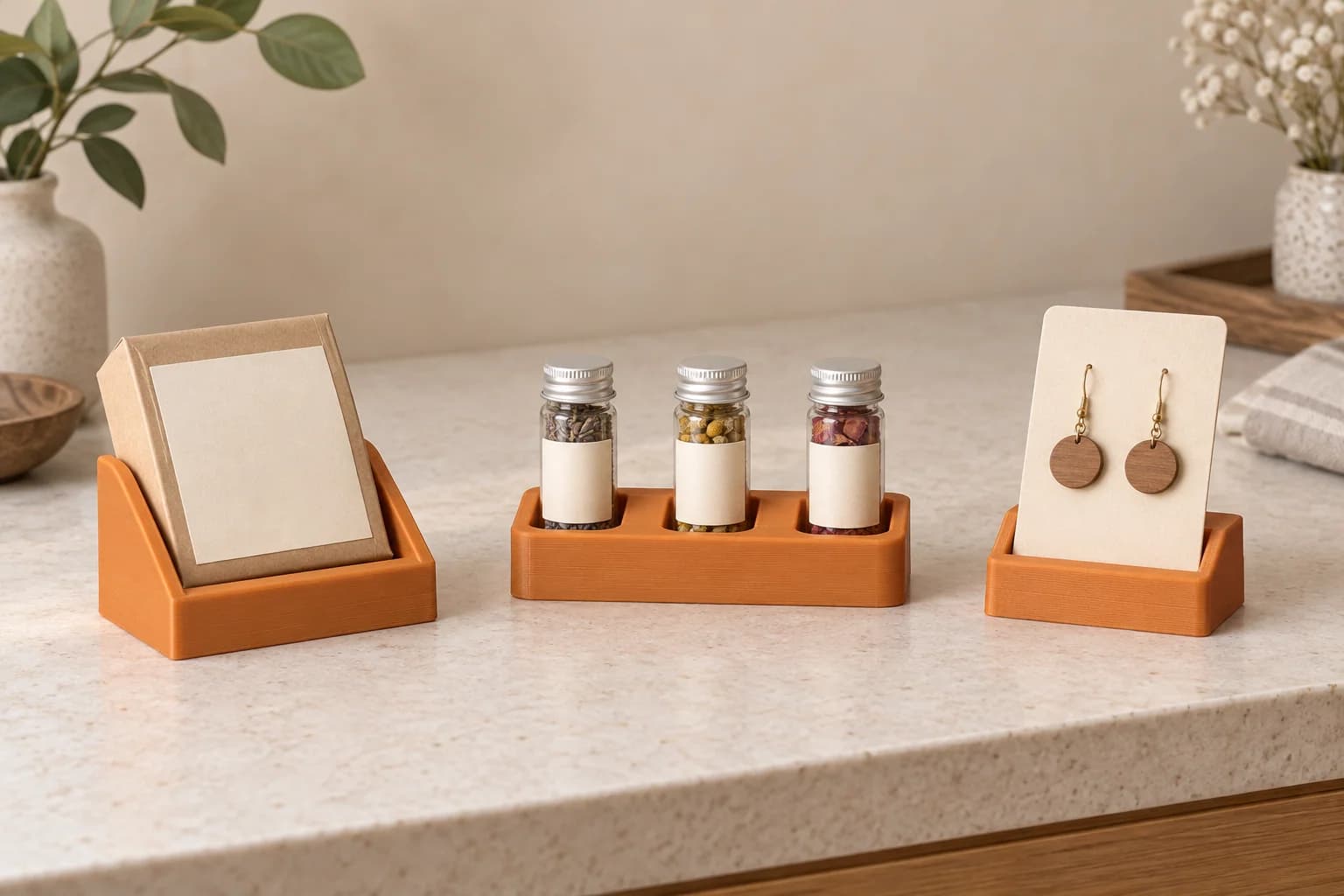
A small 3D printed retail display is worth considering when the product needs a particular pocket, angle or slot that an ordinary stand does not provide. A cradle can face a light boxed accessory towards the shopper. A shallow holder can separate sealed sample vials. A card stand can give one pair of earrings its own place on a crowded counter.
Start with that specific job. If all you need is a raised platform, a stock riser may already do it. We would compare the ready-made option before preparing a custom print, then keep the printed piece small, freestanding and easy to inspect.
Choose the shape by what the product needs
“Display stand” covers several different jobs. Raising an item, preventing it from rolling, holding its front face at an angle and separating variants each call for different geometry. Decide which job matters before choosing a model.
This is our practical decision table, rather than a set of tested specifications:
| What needs to change on the counter? | Small print concept to consider | Detail to resolve in the model | Ready-made alternative to check |
|---|---|---|---|
| One light box lies flat and hides its front | A low, angled cradle | Contact points, lower lip and removal direction | Supplier's merchandising stand or a small easel |
| Sealed sample vessels roll or crowd together | A shallow pocket holder | Actual vessel sizes, label height and room to grip each one | Original sample box or a suitable stock tray |
| Earring cards fall flat or overlap | A card-slot base | Card thickness, spacing and visible price area | Jewellery display or acrylic card holder |
| Small items need a little height | A low riser | Usable top area and counter footprint | Stock acrylic riser |
| An existing display needs one product-specific feature | A removable insert | The display's interior and the feature the insert adds | Supplier accessory or existing organizer |
The custom feature should earn its place. A pocket that matches an unusual package is a clear reason to investigate a print. A decorative shape alone is an appearance preference; it does not establish a practical advantage.
Three useful countertop briefs
These examples are hypothetical briefs for a retailer or their designer. They are not available in-house products or accounts of jobs we have completed.
A cradle for one boxed accessory
Imagine a small packaged pin or keyring that disappears when laid flat beside the till. An angled cradle could show its front while leaving the package easy to lift out.
Bring the actual package to the brief, including any hanging tab or folded seam. Specify which face must remain visible and whether the shopper should lift the box upwards or pull it forwards. A tall front wall may keep more of the package enclosed, but it may cover the very label you wanted to show. A compact base also needs enough surrounding space for the box to leave the holder.
Check the product supplier's display options first. A stand already made for that packaging may satisfy the same brief without a new model.
A holder for sealed sample vials
A sample holder needs to organize vessels while keeping their identities readable. That tension appears in a real creator example: Reddit user hannannannannah described a printed fragrance-sample stand chosen partly to keep labels visible. The creator also said handling required care, and a later version with recesses had not been tested.1
For a hypothetical shop display, specify the actual diameter and height of each sealed vessel, where its label begins, and how staff will remove a middle sample. Avoid designing around a nominal bottle size alone. A deeper pocket may cover a low label; closely spaced pockets may leave little room for fingers. Decide whether the holder is for presentation, replenishment storage, or both.
Keep this application to sealed samples. It is not a holder for unpackaged food or a dispensing surface.
A base for jewellery cards
For a market table, a separate slot base could keep one light earring card upright without surrounding it with a large frame. The brief is the card and its presentation: thickness, width, pair spacing, price position and the room needed to lift it out.
Creator Jane of ArtizoryCo offers a two-part earring-stand download intended for markets and product photography. It is a useful example of a small display model, although the public listing does not settle permission to share its files with an outside print provider.2
A card holder also lets you change the printed card independently of the base. If your existing cards already fit a stock jewellery display, compare that route before changing the whole presentation.
Count the working footprint, not just the base
A holder can fit between two objects and still be awkward to use. Its working footprint includes the product, the path used to remove it, and access for replenishment. We suggest sketching the counter from above with the intended merchandise in place.
Include these questions in the brief:
- What stays on the counter? Mark the payment terminal, receipt area and other objects that the display must fit around.
- What can the shopper see? Check the front label, the price and any rear row from the intended viewing side.
- Where does the product travel? Allow for the hand and item to move out of the holder without crossing neighbouring merchandise.
- How is it refilled? Leave staff access to the rear row or make the holder simple to remove.
- What happens when a slot is empty? Consider whether the remaining items still present clearly.
These are layout decisions, not universal ergonomic dimensions. A paper outline can help you choose a sensible envelope before a designer changes the model. Leave the detailed fit and handling evaluation to a sample made from the chosen file, material and slice.
Compare with acrylic, stock holders and supplier displays
If a clear platform is the desired look, investigate acrylic directly. Display Canada lists a two-tier acrylic countertop riser in clear, white and black, with approximate dimensions of 10 × 8 × 4 inches. Those published dimensions give you a concrete stock option to compare with your counter envelope.3
Printed stands are also sold as finished products: 3rDcoastPRINTING lists a PLA hexagonal display stand for products and collectibles.4 That listing documents an offering, rather than proving a load rating or retail result. Buying a suitable finished stand is another route alongside commissioning a model and ordering a print.
Compare the complete choice: footprint, presentation, product access, file preparation and any separate finishing. There is no automatic cost winner. A stock riser may cover several changing product ranges; a specific pocket may suit one package particularly well but need a different model when that package changes.
Care belongs in the comparison too. The Canadian Conservation Institute warns that some household cleaners can scratch or craze acrylic. Follow the display supplier's care instructions rather than assuming that transparent plastic tolerates any cleaner.5
Choose the surface and environment together
An exposed printed surface can be a deliberate part of the display's appearance. Inspect the slice for visible seams and support-contact areas. If the brief requires a smooth, glossy or precisely colour-matched finish, account for a separate finishing workflow; we do not include sanding, painting or coating in the print order.
Record the actual conditions: direct sunlight, a warm window area, transport and storage, repeated handling, spills and the cleaner staff use. Prusa's material guidance describes PLA as suitable for detailed models and prototypes, with low UV and temperature resistance. Its PETG guidance describes greater tenacity and temperature resistance, alongside appearance tradeoffs such as possible stringing.6
Those descriptions help screen choices. They do not qualify your finished holder or establish compatibility with a shop's cleaner. Choose from the materials and colours currently offered in our order flow, and resolve the specific environment with the filament or finish supplier. Changing a material does not fix a cramped pocket or an unsuitable footprint.
Bring an authorized model to the print order
Keep the model source and its permission terms. Check business use, modifications and sharing with a paid print provider before uploading. If a Creative Commons NonCommercial term is unclear for your intended use, the organisation's guidance recommends asking the rights holder or choosing a work that permits commercial use.7 Our downloaded-model guide explains the practical file checks.
At 3dPrintsToronto, we print authorized customer models supplied as compatible pre-sliced .3mf or .gcode files. If your starting point is an STL, follow our STL-to-print-ready guide and plate slicing guide. An unsliced .3mf can use opt-in auto-slicing when available. Geometry changes belong with you or your designer before file preparation.
Check one piece with the intended light merchandise before ordering a set. Stop using it if it rocks, cracks, distorts or obstructs retrieval. This article covers small countertop pieces; our terms set the service restrictions.
When the file is ready, upload it for a quote, review the parsed details and select compatible stocked filament. Quotes are in CAD. Free scheduled Toronto pickup and Canada Post shipping are available through the offered ordering options.
If the display shape is still being designed, use the form-and-fit prototype learning record to give the first sample a specific question before revising the CAD.
Once the display shape has a clear job, the countertop-prototype review sheet checks one sample with the actual package before you order the set.
Questions about small printed retail displays
Can we order a stand from a product photograph?
A photograph can help your designer understand the intended presentation, but the print order needs a compatible file. We do not include CAD modelling, scanning or reverse engineering. If no suitable authorized model exists, resolve that first with a designer.
Is PLA suitable beside a sunny shop window?
Do not assume so. PLA's documented UV and temperature limitations make the actual window conditions relevant.6 Identify sunlight and warmth before choosing a stocked material; a different material still needs a suitable model and application check.
Can we use a downloaded stand in a shop?
Only with permission covering your intended use and the way you obtain the print. A download being accessible does not settle its terms. Keep the licence or written clarification, including any restrictions on sharing digital files with the print provider.
When would you choose a stock acrylic riser?
We would investigate it when the main job is simply raising light merchandise, the available size fits, and a clear platform suits the presentation. A print becomes more relevant when a particular slot, pocket or angle is the missing feature.
Sources checked
hannannannannah's fragrance-sample stand and creator replies, verified: 2026-10-05. Firsthand personal-use account; not a verified retail installation or a tested revised design.
Return to text: 1
Jane / ArtizoryCo's earring-stand listing, verified: 2026-10-05. The public description allows a limited number of physical products and restricts digital-file sharing. We have not acquired the files or cleared an outsourced order.
Return to text: 1
Display Canada's two-tier acrylic step riser, verified: 2026-10-05. Supplier listing; dimensions are stated as approximate. No claim here about current stock, price or tested performance.
Return to text: 1
3rDcoastPRINTING's retail display stand, verified: 2026-10-05. Firsthand seller listing, cited only as an example of an offered printed stand.
Return to text: 1
Canadian Conservation Institute: cleaning glass and acrylic display cases, verified: 2026-10-05. Acrylic-sheet care guidance, not a cleaning instruction for printed PLA or PETG.
Return to text: 1
Prusa's PLA guide and PETG guide, verified: 2026-10-05. General manufacturer screening guidance, not a finished-part test or certification.
Creative Commons FAQ on the NonCommercial condition, verified: 2026-10-05. General licence guidance; no individual model clearance is implied.
Return to text: 1
Have a sliced file ready?
Upload it for an instant quote in CAD.